Partner discovery at LiveRamp
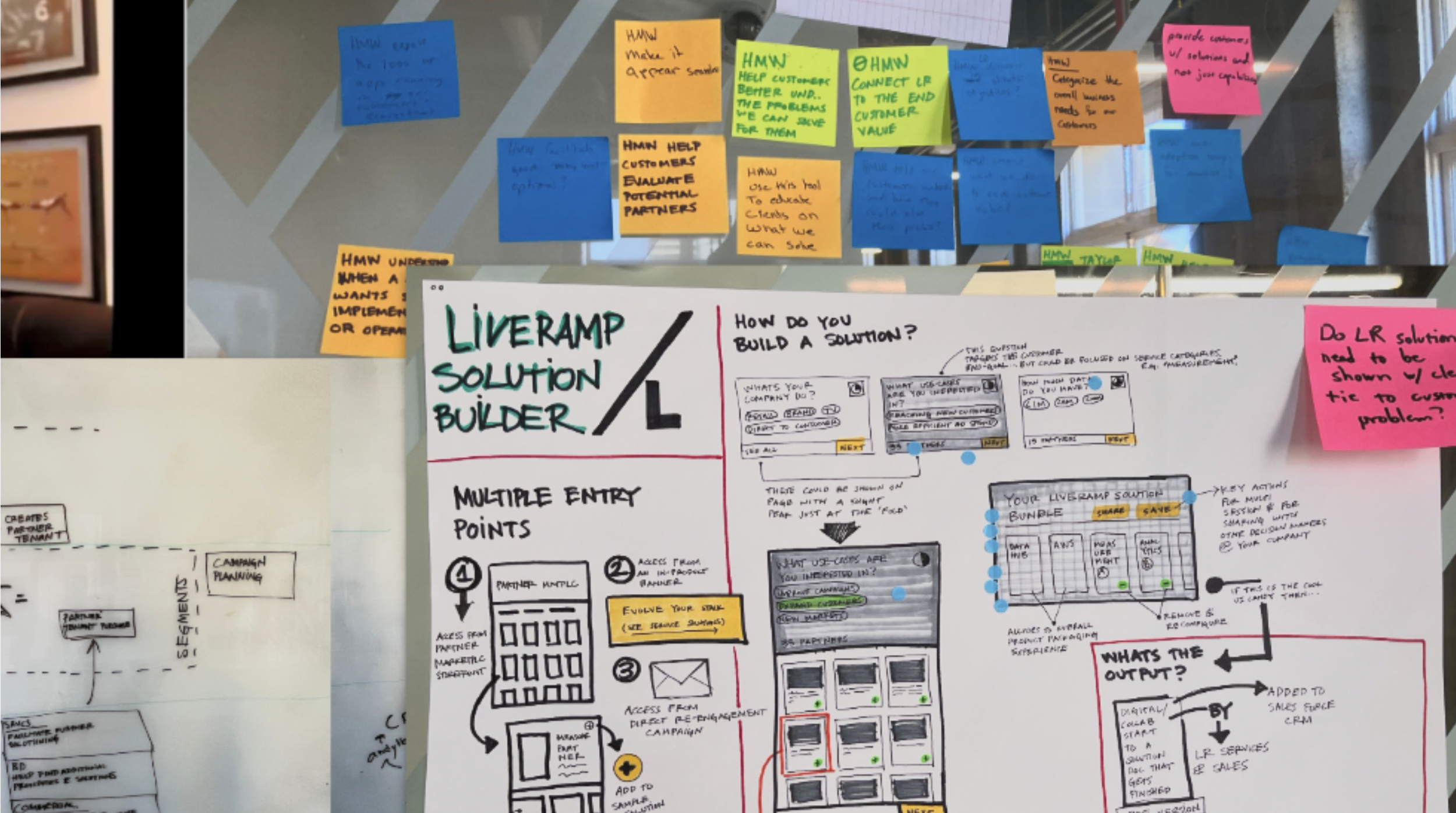
A design sprint that turned two competing executive asks into a funded, validated roadmap.
Role: Sprint lead and facilitator | Team: Cross-discipline sprint team, UXR, PM | Timeline: 1 week sprint | Deliverables: Prototype, research findings, phased proposal
Two stakeholders, two competing solutions.
About a year into LiveRamp, two stakeholders approached me with two different asks. The Chief Strategy Officer had found a quizlet he liked: a flashy UI that kicked off a sales motion. The Director of Business Development wanted a marketplace storefront where partners could market their services. Both wanted the same things underneath, new integration revenue and better retention. I knew the partner space, but I didn't yet understand when and how our customers actually engaged partners.
The real problem: churn we couldn't build our way out of.
The asks pointed at a real business problem. Clients were churning because the platform lacked very specific functionality that would be prohibitively expensive to custom build for a handful of accounts. Some of those clients were happy with our core capabilities but couldn't justify staying when a competitor with a weaker graph had their one specific need.
I proposed a sprint instead of picking a side.
Both stakeholders were jumping straight to solutions. Rather than crown one, I proposed the Design Sprint format: a fast way to understand the problem, build a prototype, and let customer feedback shape the strategy. It was also a good reason to get out of the house after years of working at home, and build some camaraderie across the company.
The homework before the sprint.
I worked with UXR to synthesize customer answers to the persona survey question "What capabilities do you wish LiveRamp products had?" and ran a Lightning Decision Jam to source additional customer problems from internal stakeholders. These exercises decided what we would go after, and just as importantly, what wouldn't be in scope.
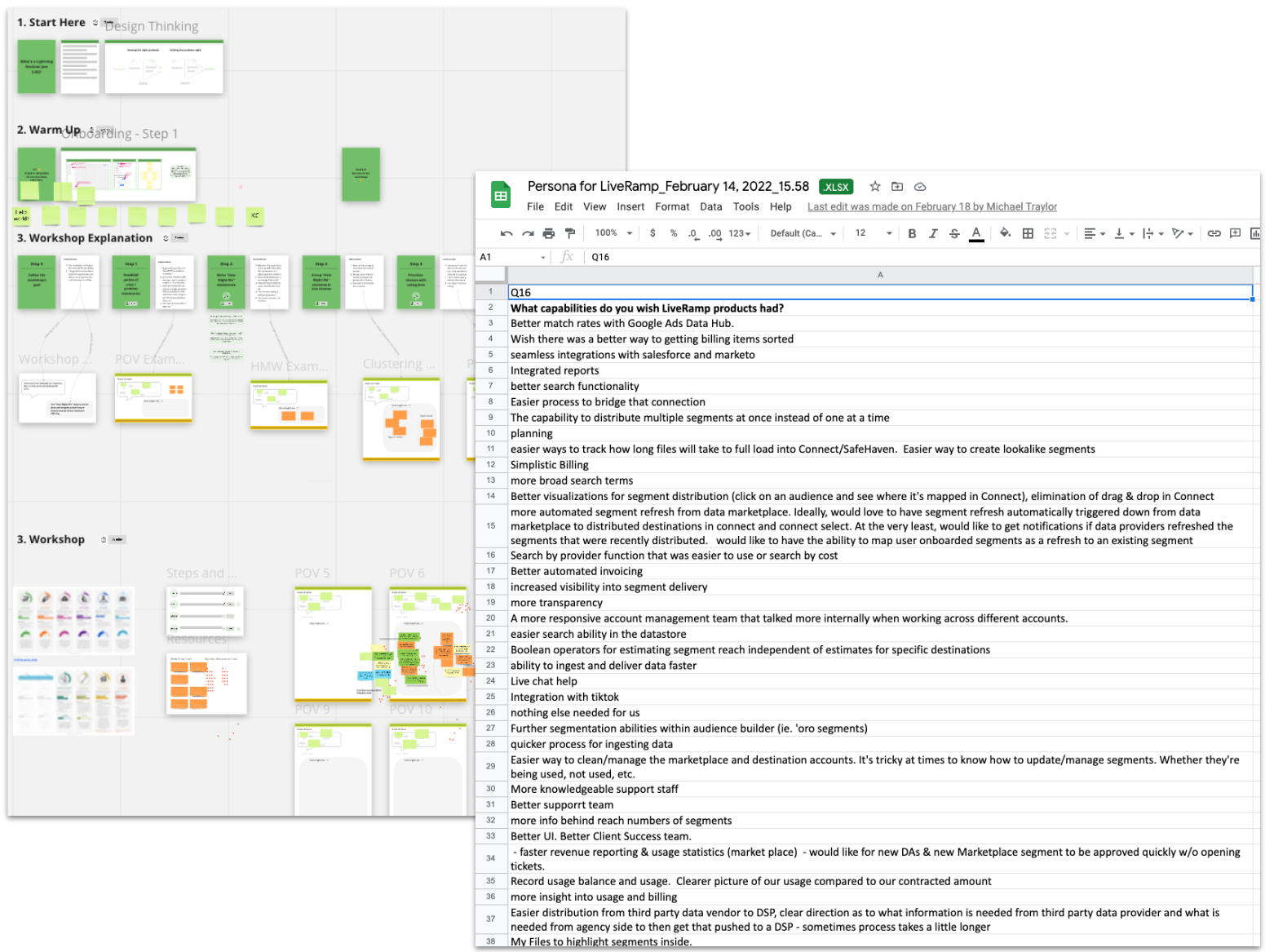
“Lightning Decision Jam” board and survey answers
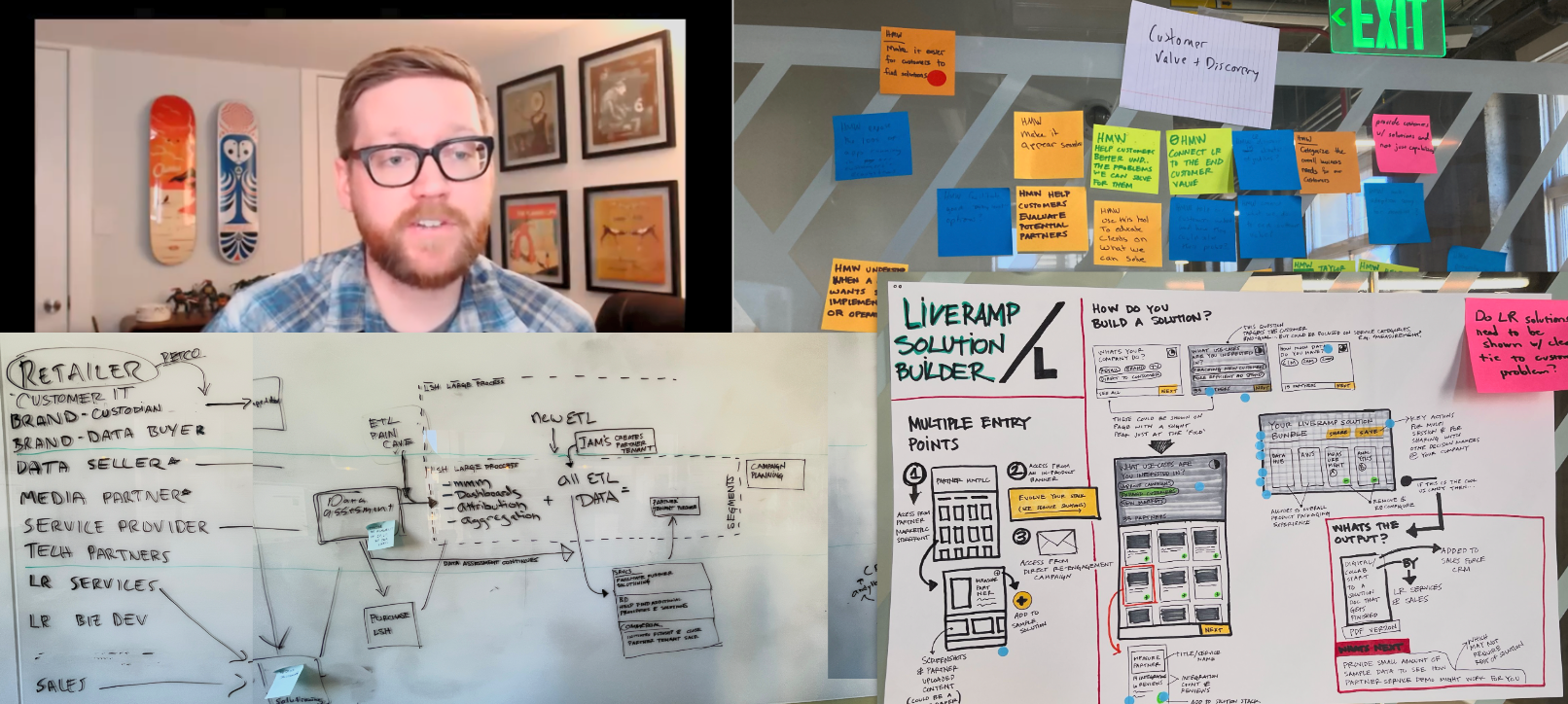
Day 1: establish a goal (optimism), ask the hard questions (pessimism).
We established the long-term goal: "Customers can seamlessly discover and engage with solutions and partners that meet their needs." Then we asked how it could fail: Will customers find the right solution? How does LiveRamp stand out? Is this really worth investing in? SME interviews ran throughout, refining the goal, the questions, and a journey map that started out super messy and helped us zero in on something attainable. We scoped to the needs-assessment part of the journey and the Analytics Lead persona.
Sketch, decide, storyboard, build.
Day 2, everyone sketches, then sells their best idea to the room; solutions have to stand up to criticism on their own. Day 3, the team votes, the decider supervotes, and must-haves get separated from maybe-laters as the storyboard emerges. Day 4, the designers went heads down on the prototype while our research and PM leads crafted the interview script. When in doubt, we went with the riskier choice, since we were a day from validating with users.
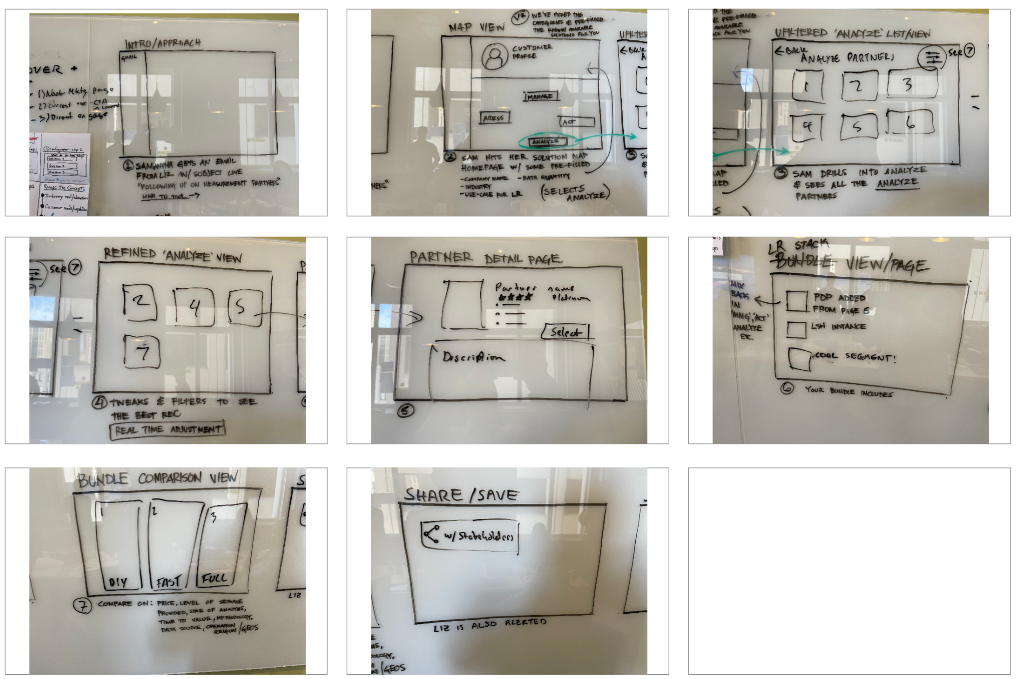
The hypothesis: partners are worth more bundled with solutions than listed alone.
The team's bet was that there's more value in bundling partners with their solutions and LiveRamp's products than in a directory of partner info. The prototype was built around it
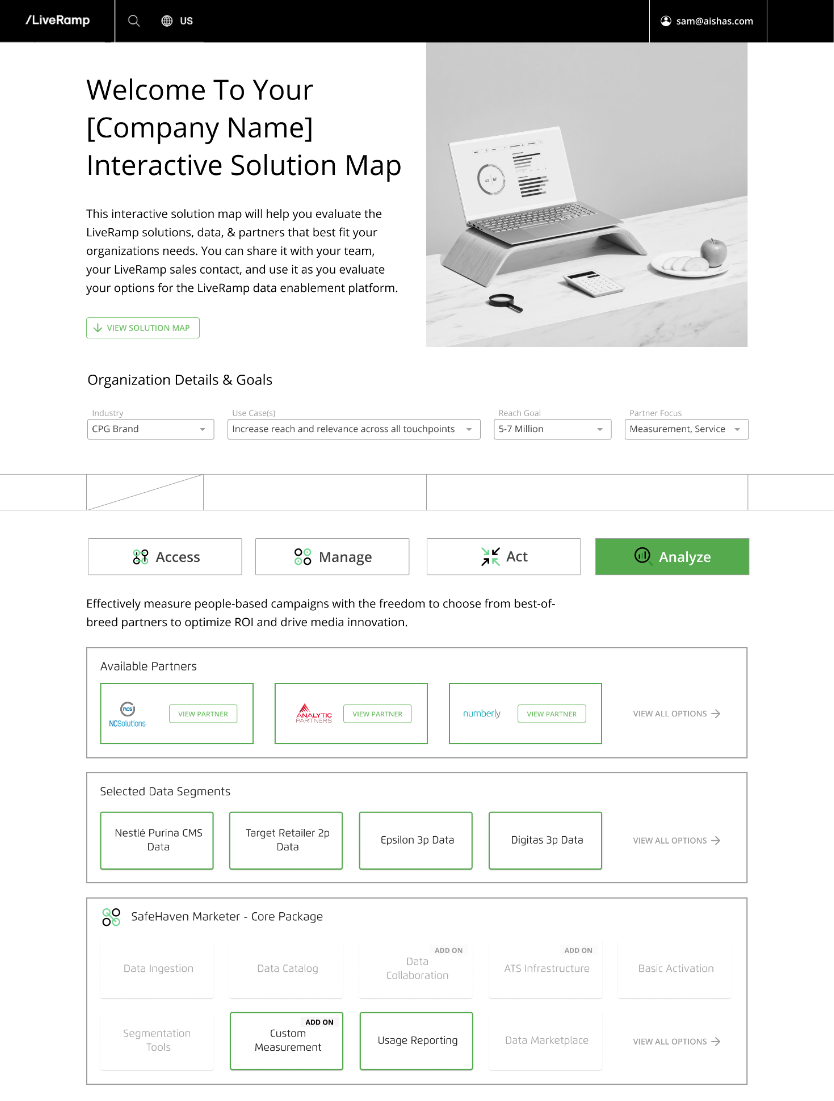
Step 1: Solution builder landing page. The journey could start with a Commercial Lead sending an interactive solution map to a current or prospective client. The end user could also initiate this themselves.
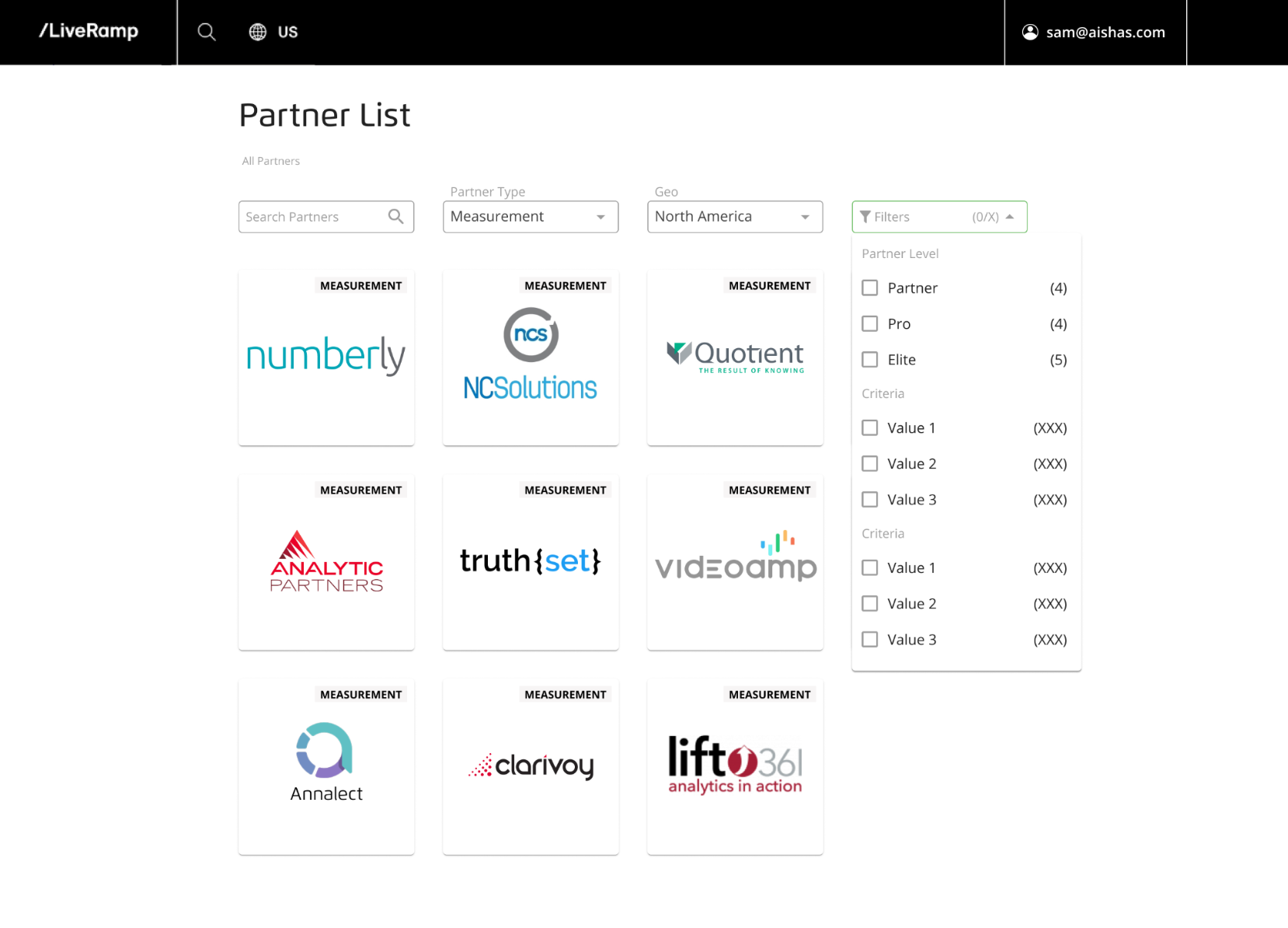
Step 2: Partner browse view. The user browse alternatives to the suggested partners and filter down by their specific criteria.
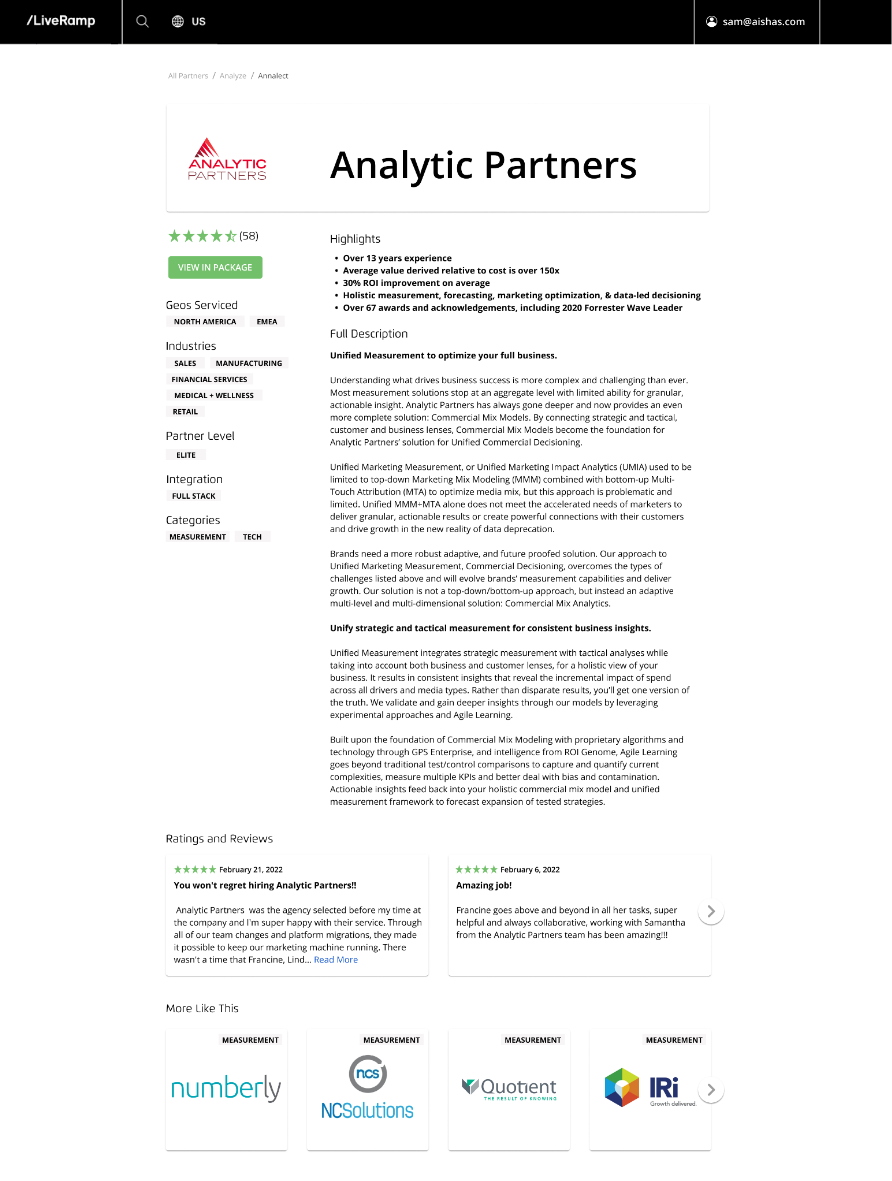
Step 3: Partner listing page. The user can select any partner to learn more and see their full offering.
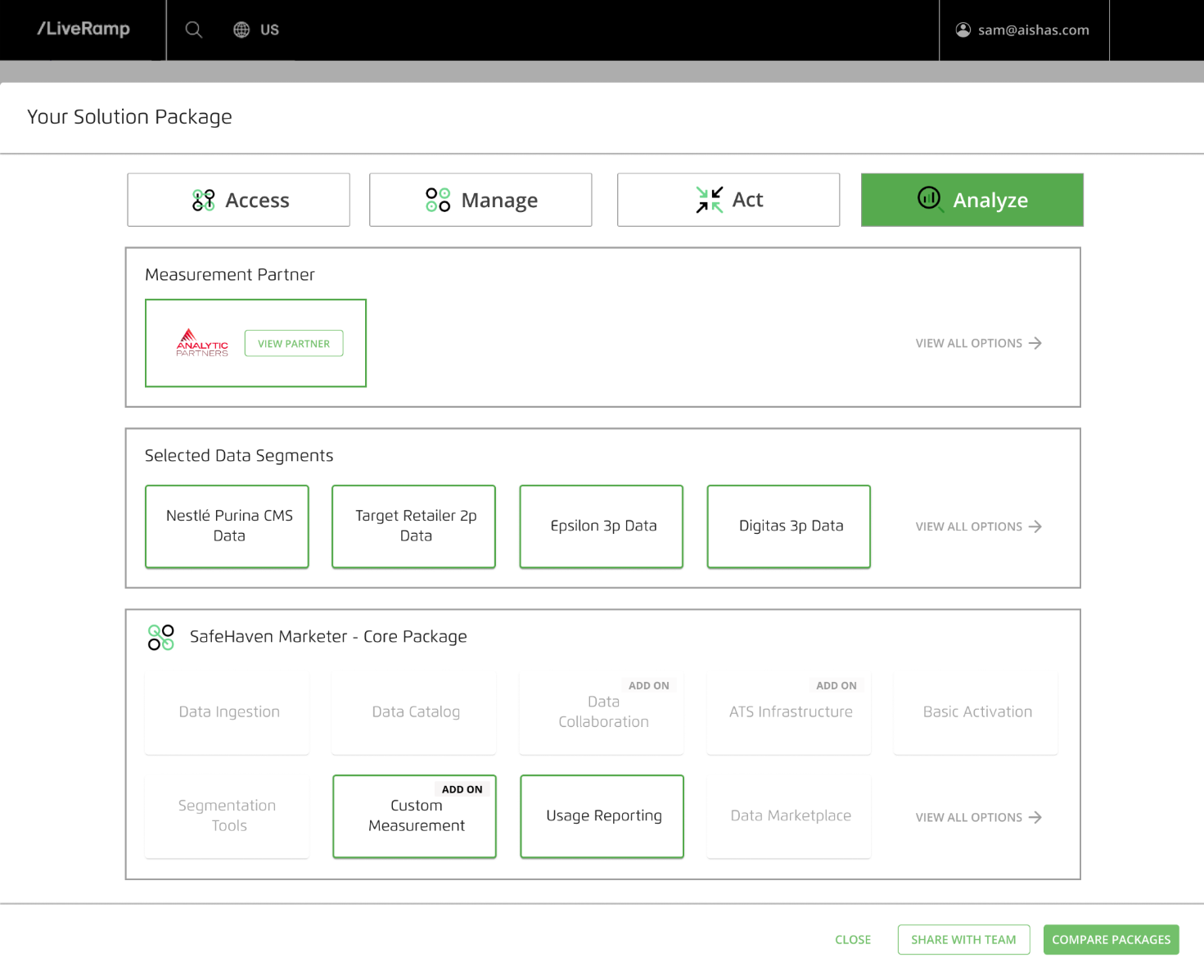
Step 4: View and edit package. The user can add a partner or any aspect of LiveRamp's offerings to their solutions package.
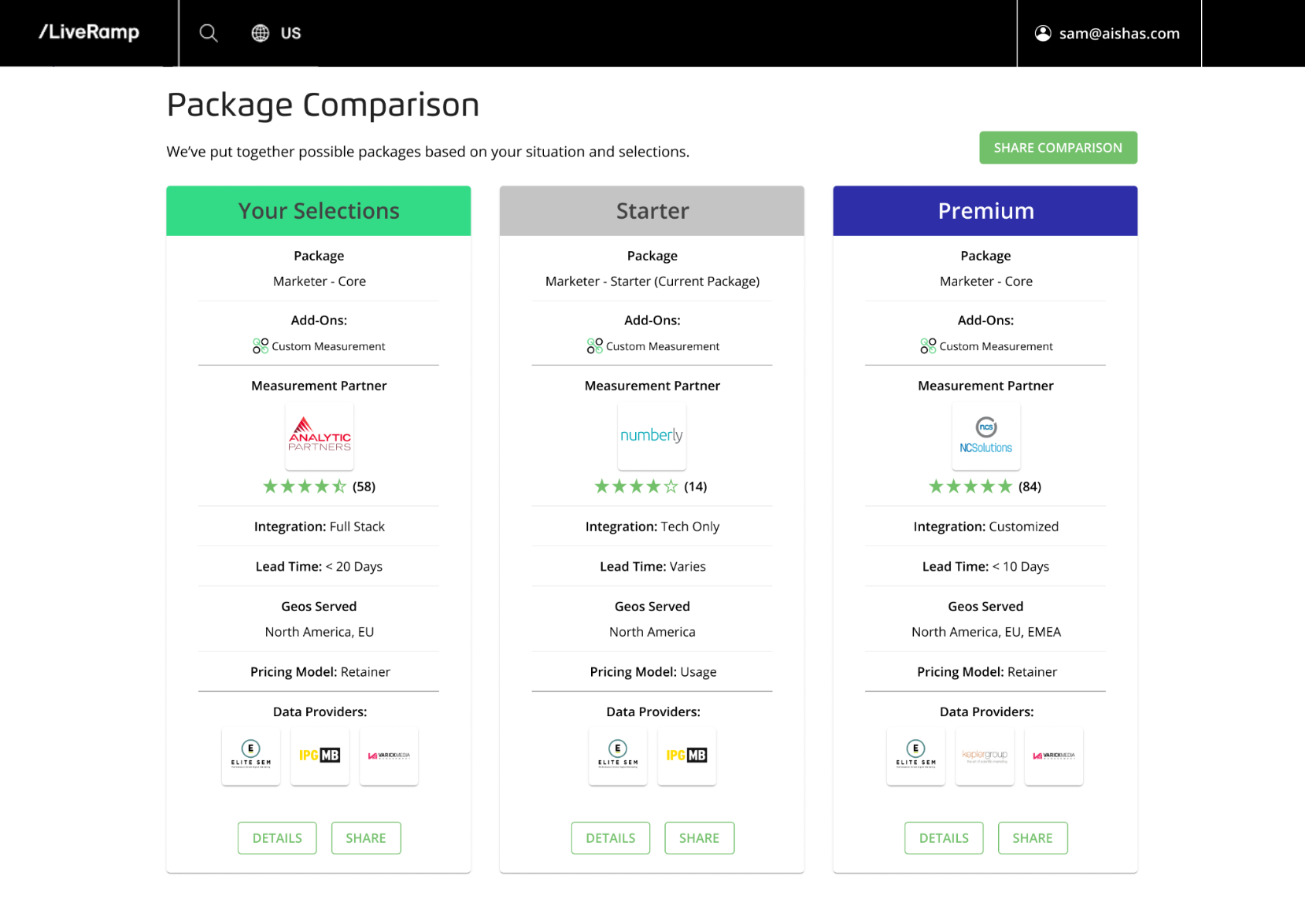
Step 5: Compare packages. The user can compare selections to those generated by the system or the sales team.
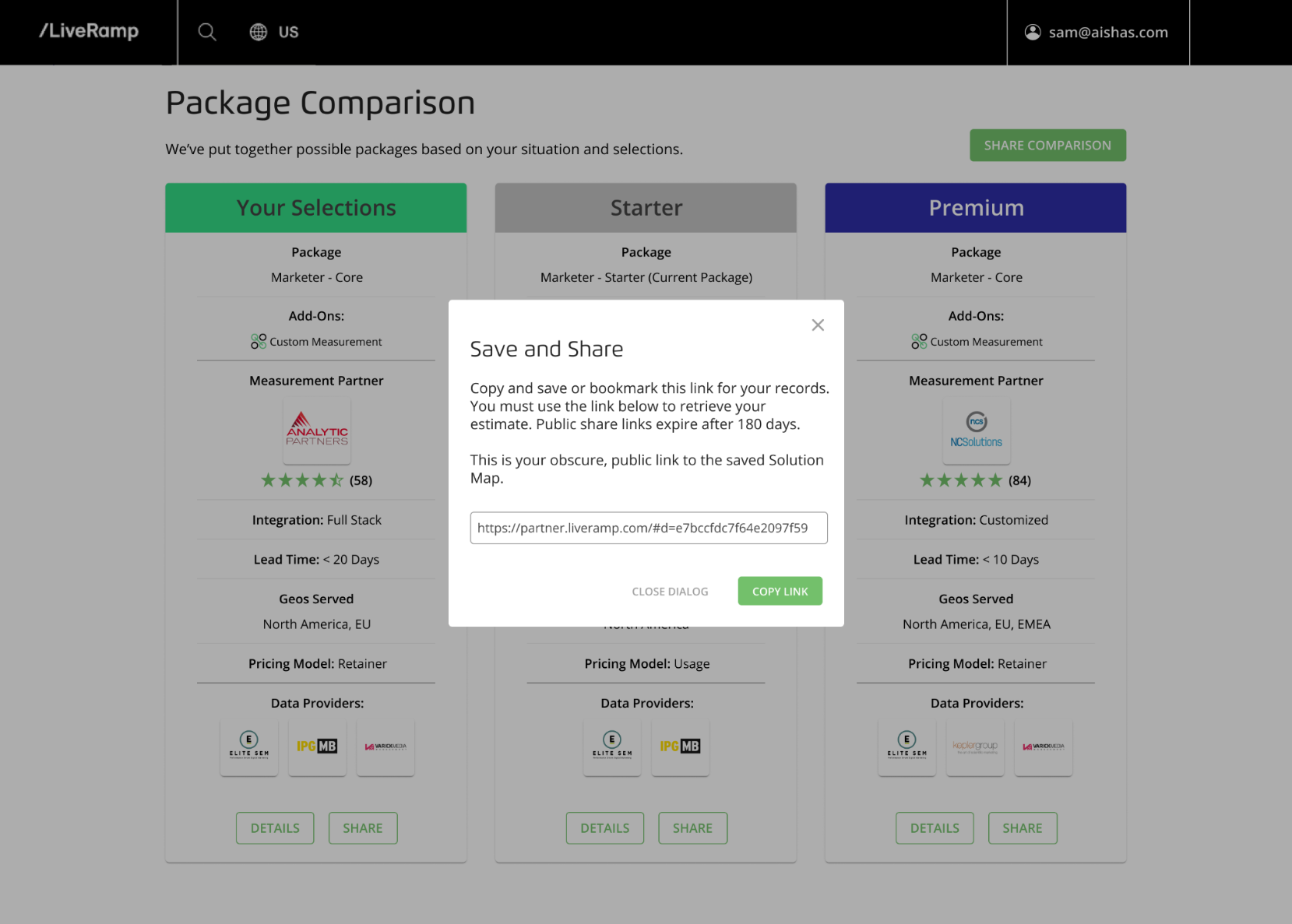
Post Script: Share. Decision makers and users are rarely the same person. From the interviews, we felt that being able to conveniently share this information was important to include.
What five customers told us.
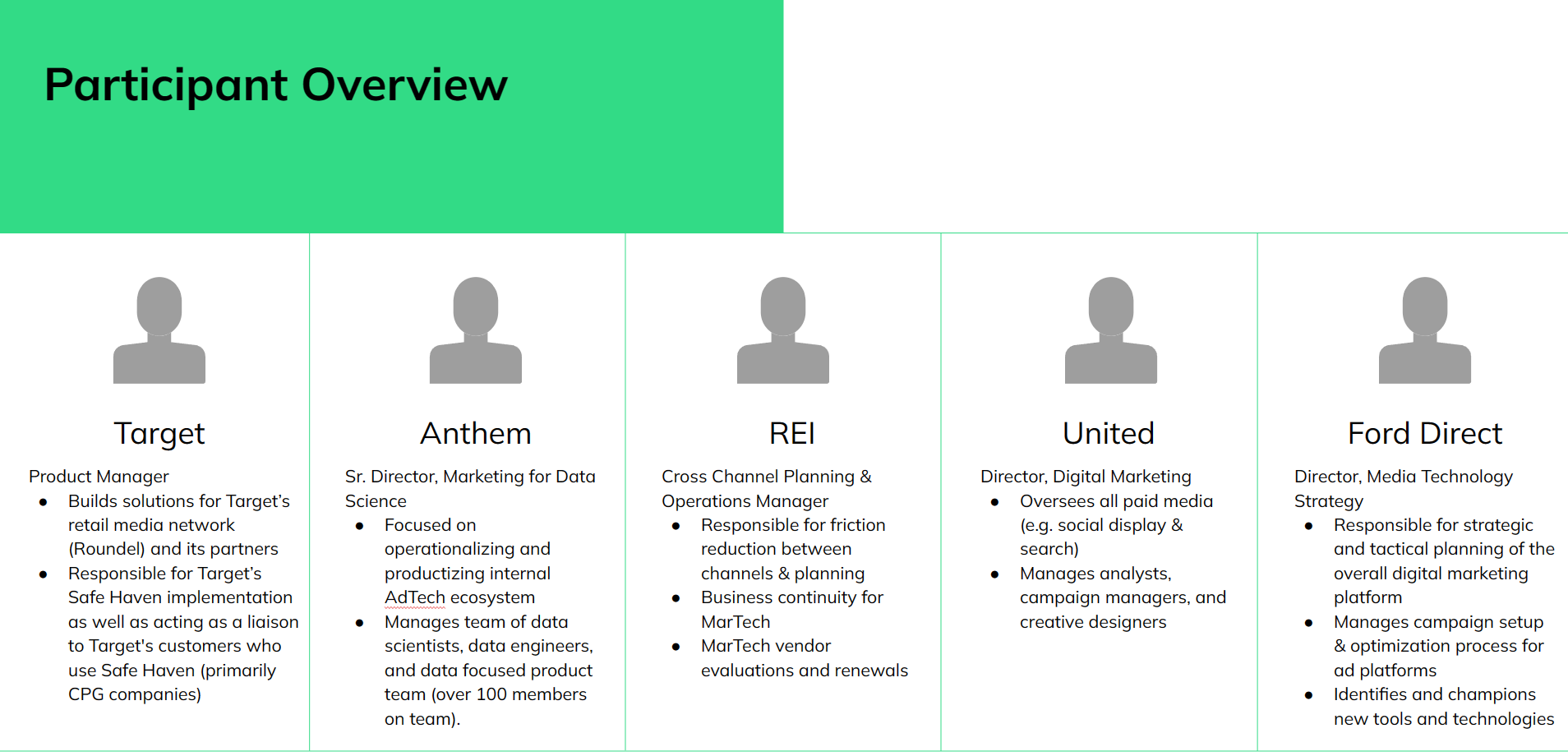
The prototype (above) was mid fidelity elaborate on purpose, to validate and challenge some of our wilder ideas. And do it quickly. We ran research sessions with five participants across different industries. The insights that mattered:
- Customers need help discovering partners.
- Customers don't pick partners alone. Marketing, Legal, Procurement, and IT typically work together on selection, vetting, and onboarding.
- Pricing and relevant experience get the closest look.
- Matching partners to use cases is valuable.
- The revised information architecture wasn't obvious. Customers were confused by "Access, Manage, Act, Analyze," and that feedback drove a clearer, object-oriented nav.
- Subjective partner labels like "preferred" and "premium" demand transparency.
- Pre-populating customer info and sharing with stakeholders were winning features.
The proposal: three phases, each with an exit ramp.
The initiative was funded, with gates built in to keep asking whether it was still the right plan.
Phase I, Partner Curation (MVP): Public launch featuring 3-5 top use cases on LiveRamp.com. Measure engagement before proceeding.
Phase II, Product Integration: Integrate into the Enterprise Platform and add use cases. Measure again before proceeding.
Phase III, Partner Integration: Go beyond curation and integrate deeply with partners to accelerate transactions and onboarding.
It was not, in fact, the right plan. And the company chose buy over build.
The sprint had convinced me that LiveRamp is really good in a lot of areas, but the bigger opportunity was strategically aligning with industry frenemies to get our shared customers to their goals. The company reached the same conclusion, with a bigger budget. Strategy moved, and LiveRamp went all-in on data collaboration and acquired Habu, a clean room offering. Building our own partner marketplace no longer made sense. That's what the phase gates were for: we built in the option to stop, and the company used it.
Plenty survived, though. The IA feedback shipped as a clearer, object-oriented nav. The funded proposal validated partner discovery as an actual customer need. The over-arching marketplace concept would be used for clean room partner matching. And "what are you trying to do today?" proved so useful as a starting point that it carried it into everything since, including the intent-driven wizard in my self-serve data access work.